

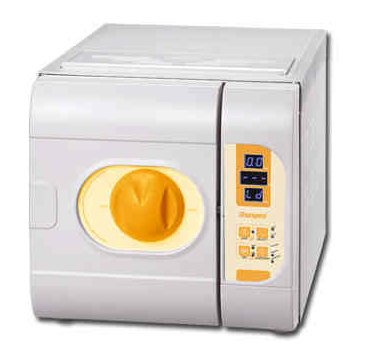
In some medical facilities and laboratories, the use of sterile disposable instruments is now standard practice, but there are still a number of reusable instruments that need to be sterilised. When deciding to purchase an autoclave, two important aspects should be considered. Firstly: In what type of facility will the steriliser be used? Which autoclave class should be selected, i.e. a brief description of the equipment for pressure sterilisation with steam In some medical facilities and laboratories, the use of sterile disposable devices is now standard practice, but there are still a number of reusable devices that need to be sterilised. When deciding to purchase an autoclave, two important aspects should be considered. Firstly, in which facilities will the steriliser be used? Secondly, we must ask ourselves what type of material we will be sterilising and what it is intended for. Sterilisers that use hot steam under pressure as a sterilising agent, or autoclaves to put it simply, can be divided into three classes. The highest class, Class B autoclaves, includes devices that can sterilise all types of materials, especially capillary instruments, which pose particular problems during autoclaving (so-called type A loads). The distinguishing feature of these devices compared to the others is the so-called fractionated pre-vacuum. This involves completely removing the air from the material to be sterilised by creating a vacuum and injecting steam several times in succession during the initial phase of the process. This is currently the best and most effective technique available, guaranteeing the sterilisation of virtually all types of products. Class B autoclaves are commonly used in clinical facilities and hospitals, as well as in doctors' surgeries. One step below in the classification are Class S autoclaves, which are mainly intended for use in laboratories and doctors' surgeries where no equipment classified as Type A batches is sterilised. Here, too, the autoclave is designed to be used in a controlled environment.for use in laboratories and doctors' surgeries, where no equipment classified as type A batches is sterilised. Here too, the air is evacuated from the chamber before the actual sterilisation process begins, but this process is much less complex than withThe vacuum is created using a small pump, but this process only takes place once. Another point to consider when selecting equipment is its ability to effectively dry the batches, especially the packaged ones. We should consider whether the microbiological purity of the materials or packaged items can still be guaranteed if they are damp. Class B and S devices use vacuum drying, which makes this process very efficient and smooth.and allows us to remove a completely dried, ready-to-use insert from the autoclave after sterilisation is complete. The lack of effective drying is a major problem. We encounter it in autoclaves of the lowest class N. These are primarily intended for the sterilisation of simple, unpackaged materials. The manufacturers recommend starting an additional drying programme after opening the device, but this is sometimes difficult and the sterilisation is not always completely successful.However, this can sometimes be difficult and the sterility of the batch sometimes remains controversial. The principle of vacuum generation is slightly different here than in class B and S sterilisers. The thermodynamic vacuum system, which is based on the self-acting effect of water vapour that pushes the air out, is very common. Unfortunately, this process is unevenand only allows for the sterilisation of solid instruments. Although Class N autoclaves have lower functional properties in terms of the types of batches that can be sterilised, they are characterised by a high technical standard. If we pay attention to the correct composition of the batch and additional drying, these devices will serve us with high efficiency. When considering the technical parameters, several aspects must be taken into account. The first of these is the capacity of the chamber.considering the technical parameters, several aspects must be taken into account. The first of these is the capacity of the chamber, bearing in mind that the performance of the device is determined by its so-called useful volume, i.e. the actual space that the batch can occupy.¤chlichen Raum, den die Charge einnehmen kann. This is always a few to several percent smaller than the physical dimensions, which is due to the fact that the sterilising agent must have sufficient space to reach all components of the batch equally.In classes B and S, we are usually dealing with chambers with a capacity of 4.8 l to 24 l. Sometimes there are even values of up to 65 l for the sterilisation of large quantities of material. In class N, the size range of the chamber is similar, with manufacturers usually offering autoclaves with a capacity of several litres. Another important parameter is the limits of the programmed temperature. The most common range is between 117 °C and 134 °C, but there are also devices where the scale starts below 100 °C. This is of great importance, as it allows sterilisation programmes to be created that are optimally tailored to individual requirements. With most devices available on the market,In medical facilities, autoclaves of the two highest classes are the most popular. Depending on the manufacturer, the following options are standard or available as extras:
- generated with a vacuum pump: pre-vacuum, fractionated vacuum and drying,
- control of all functions via a microprocessor,
- Chamber and frame made of stainless steel,
- Intake air filter to protect the batch from microbial contamination,
- automatic electromagnetic closing of the door after the start of the cycle, which means that¤hring the programme, no material can be added and at the same time protects personnel from accidentally opening the autoclave when there is high pressure in the chamber,
- fixed sterilisation programmes, test programmes + additional option to create your own sequences,
- Error alarms,
- Automatic water intake and drainage
- Integrated printer
- Connection option to a computer or portable memory card,
- Additional work, cassettes or other containers for sterilised material.
Author: Medical Online 19.09.2012


